How it works

How a fee explains itself.

Mark who showed up. Each attended class fills a bead, the cycle adds up in plain sight, and the fee falls due only when it’s complete — so everyone already understands why.

Step one

Mark attendance in a tap.

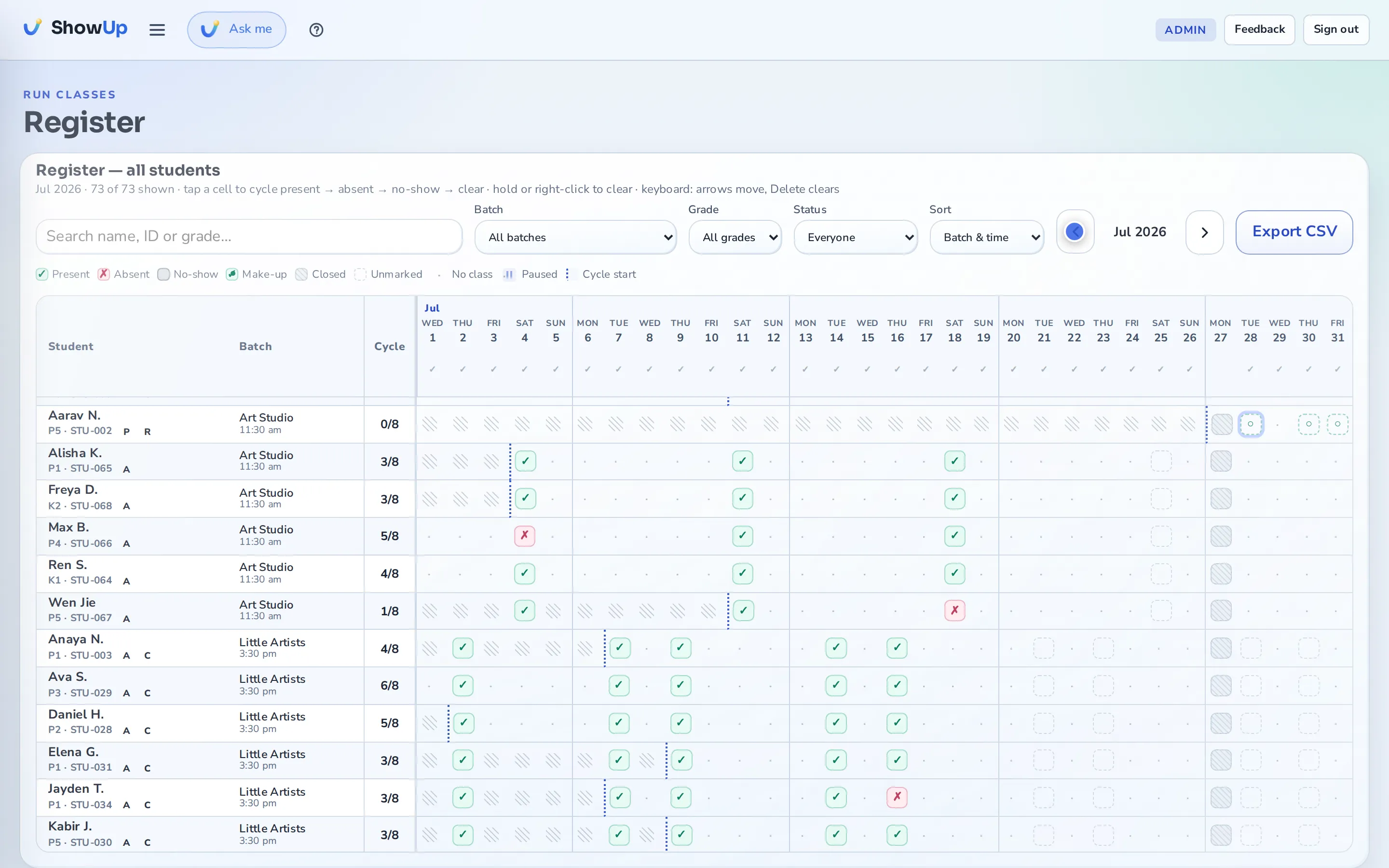
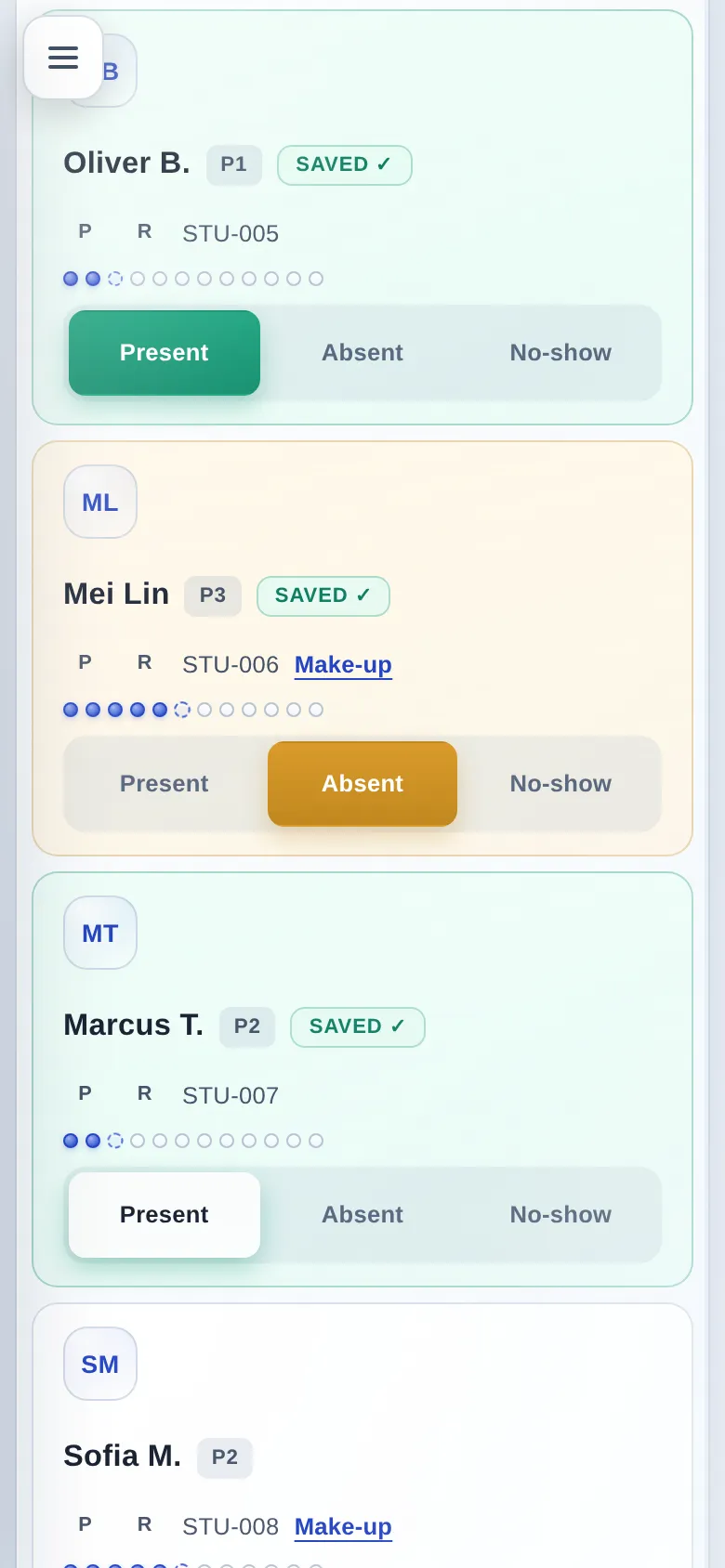
The whole system runs on one honest daily act: who showed up. Tap a name to mark today — present fills the next bead, absent leaves the meter.

Today’s register Marked

Tap a name to mark today’s class. A fee falls due only when every bead is filled.

That single tap is the only thing ShowUp asks of you each class. Cycles, dues, reminders and the family view all flow from it — no calendar to wrangle, no invoice to write.

The fair rule

An absence never burns a class.

Two students, same cycle, today. One is present, one is away — watch what the meter does.

Marked present

A present class fills the next bead. The meter ticks up, one class closer to a complete cycle.

6 of 8

Marked absent

Mark an absence and the meter holds. A missed class is not a paid class — the cycle simply waits for the next one.

Still 5 of 8

The whole cycle

Attendance, all the way to a fee.

The complete journey: a cycle opens, fills class by class, turns gold when it’s done, and only then does a fee fall due — paid, and the next cycle opens itself.

  1. A cycle opens

    Each student gets a prepaid cycle — a set number of classes to attend. It starts at zero and waits.

    New cycle
  2. Attendance in a tap

    Mark who showed up. Every present class fills one bead — the meter ticks up, class by class.

    3 of 8
  3. An absence never burns a class

    Mark an absence and the meter holds. A missed class is not a paid class — the cycle simply waits for the next one.

    Still 5 of 8
  4. The cycle completes

    When the last class is attended, the beads turn to gold. The chapter is done — and only now does a fee fall due.

    Chapter complete
  5. Everyone hears the same story

    The family is notified in plain language: the cycle is finished and the fee is due. No surprises, no maths to argue.

    Fee due
  6. Paid, and the next cycle begins

    The owner marks the fee received, and a fresh cycle opens automatically. The rhythm continues.

    Paid · next cycle

No surprises

Everyone hears the same story.

When a cycle completes, the family and the owner see the very same thing — so there’s nothing to argue about.

Fee due

The family is notified

The family is notified in plain language: the cycle is finished and the fee is due. No surprises, no maths to argue.

Paid

The owner marks it paid

One tap records the fee as received — no chasing a number nobody understands, no awkward maths at the door.

New cycle

The next cycle opens

The owner marks the fee received, and a fresh cycle opens automatically. The rhythm continues.

Why nobody argues

A bill that explains itself.

Fees are tied to delivered classes, not the calendar — and because the cycle is visible, the amount makes its own case.

01

Attend first, pay later

A fee is tied to delivered classes, not a calendar month. Families pay for what their child actually received.

02

Every fee has a reason

Because the cycle is visible, a due amount explains itself. That is what makes it dispute-free.

03

One cycle at a time

Each student has a single live cycle. No overlapping bills, no guessing where they stand.

Every centre is set up in its own currency, timezone and holidays — so the maths a family sees is always the maths for their classes, in their world.

Good questions

Questions about the cycle.

When exactly does a fee fall due?

Only when every class in a student’s prepaid cycle has actually been attended. Until the last class is marked present, nothing is owed. That is what makes the amount easy to explain — and hard to dispute.

What happens when a student is absent?

Nothing is lost. An absence does not consume a class — the cycle simply waits for the next attended session. A missed class is never a paid class.

Can a student be on more than one cycle at once?

Each student has a single live cycle, so there is never an overlapping or confusing bill. When one cycle completes and the fee is settled, the next opens automatically.

Founder pilot — free for a limited period.

Run your classes on attendance.

Join the founder pilot and let the fees take care of themselves — fairly, and without a single argument.